 Disable/Enable big cursor white
 Disable/Enable big cursor black
 תרמו לנו


נאומה של רגד ג'ראיסי בקבלת פרס גלנטר
Masaa al-khair and good afternoon everyone.
I’m truly excited – and deeply moved – to be here with you tonight.
It’s been a powerful day of meaningful and hopeful conversations, and I’m honored to end it by standing here, in front of this room full of people who care so deeply and act so boldly for justice, equality, and peace.
First, I want to thank the Galanter family, whose generosity makes this award possible year after year. Receiving this prize – this year, of all years – comes with very mixed emotions. It has been a painful and difficult time. A time of deep sorrow, profound loss, relentless struggle, and challenges from every direction. And yet, alongside all that, what I feel most in this moment is a deep sense of recognition and solidarity – a signal that even in the darkest of times, we are not alone. This award, to me, is also a symbol of hope. A reminder that there is still a horizon – Aufoq, we can look toward, even when the sky feels so full of clouds.
Thank you to the organizers of this amazing gala, to the New Israel Fund in San Francisco and in Israel, and to all NIF partners around the world. Thank you for continuing to stand with us – even now, especially now, and for raising your voices to demand an end to war. For standing for peace. For insisting on ending the occupation, and on building a future rooted in justice, equality, and partnership for all who live in Israel and Palestine.
Thank you Orly and Daniel, Hanna, Miki, Shira, Fidaa, and the whole NIF team—thank you for your partnership, for your trust, and for being an anchor in the stormiest of times.
And to my colleagues at Sikkuy-Aufoq – this award is yours as much as mine. It is only because of your tireless, principled, and courageous work that I can stand here tonight and speak of hope. Thank you for holding us together in a time when division seems to be the way. And to my co-director, Ofer Dagan – thank you for your friendship, your trust, your professionalism, and your relentless commitment to our shared vision.
Let me start by telling you a bit about myself.
I’m a 37-year-old Palestinian woman, a citizen of Israel, originally from Nazareth – the political heart of the Palestinian community in Israel. Today, I live in Nof Hagalil, a neighboring city built in the 1950’s as part of a state plan to “Judaize the Galilee.”.
Over the years, Nof Hagalil (that until recently was called Natzrat Illit – Upper Nazareth) became home to many Arab families from Nazareth and nearby villages – some in search of better living conditions and a higher quality of life, others out of necessity, due to the severe housing crisis and neglect in Arab towns.
That’s how Nof Hagalil became what is officially considered a mixed city. But in everyday life, Arab residents remain largely marginalized and excluded from public services and the education system.
I live there with my husband Wasim, who’s here with me today, and my two little kids, Aadel and Ramiz – the light of my life.
I come from two families that survived the Nakba – the Palestinian Katastrophy. I am among the descendants who were able to remain on their land, but the consequences of that foundational trauma have shaped every aspect of our lives – from access to housing and education to a sense of citizenship and belonging, and has contributed to our political social activism.
My family has always been a deeply political and activist Palestinian family. From a young age, My father and late mother raised me to recognize and understand the deep inequalities between Jews and Arabs in Israel and the injustice of the occupation. I came of age during the Second Intifada, a time of intense political violence and polarization. My family helped shape my national and political identity – protests, community meetings, and civil society activism were part of my everyday life.
But just as they raised me to fight for Palestinian rights, they also made sure I understood that my freedom cannot come at the expense of someone else’s freedom. That human rights are universal, and successful political struggles are stronger when they are shared. They taught me that justice, if it is to be real, must be justice for everyone.
So while they nurtured my Palestinian identity, they also opened doors for me to see and know the other. I joined the Arab-Jewish Youth Orchestra at a very young age, and I traveled the world with my Oud and with friends – Arab and Jewish – who believed in the power of shared music and shared humanity.
And even there, in that beautiful space of partnership, I encountered the harsh reality of inequality. I remember the long interrogations at the airport, the humiliating searches in front of my fellow musicians and strangers, the way I was treated just because of who I am.
Professionally, I began as a young lawyer at the Association for Civil Rights in Israel. I defended Palestinians under occupation and challenged discrimination against Palestinian citizens of Israel. Over time, I shifted into policy work – researching inequalities, advocating within government ministries, and pushing for structural change of the basis for equality and partnership.
Today, as co-director of Sikkuy-Aufoq, I help lead a joint Arab-Jewish organization that works for true equality and a shared society in Israel. We believe that equality isn’t a favor – it’s a right. And partnership isn’t a dream – it must become our reality.
It’s true – inequality and injustice did not begin on October 7. There was already a conflict. There was occupation. There was oppression. There was inequality and discrimination inside the state. Life was not easy.
For years, we at Sikkuy-Aufoq worked to close gaps in transportation, healthcare, education, and housing. We’ve supported unrecognized Bedouin villages in the Naqab. We’ve helped shape five-year government plans for Socio-economic development of Arab society. But the work is harder now – and the threats are greater.
And still – there is no denying that the events of October 7 shook the ground beneath us.
In a single day, over a thousand people were Murdered. Entire communities were destroyed. For tens of thousands of residents of the attacked and evacuated townships, and for all the citizens of Israel, life will never be the same.
And then came the war on Gaza. A war that has displaced more than a million people. That has killed tens of thousands – women, children, the elderly. That has left behind unimaginable devastation. A war whose crimes and consequences humanity will remember for generations.
Both October 7 and the war have been so profoundly traumatic, they sent shockwaves around the world – felt especially deeply by those who, like so many of you here, have dedicated their lives to the pursuit of human rights, justice, and peace.
The pain is overwhelming. The grief knows no borders.
Within Israel, the war has been a powerful enabler for the government to advance its frightening agenda against democracy, against Arab citizens, and against Jewish-Arab partnership and equality – principles that Sikkuy-Aufoq has long worked to achieve as the necessary foundations for a just future. Early in 2023, we identified dangers in coalition agreements threatening democracy and Arab society. While we and others in civil society initially blocked a number of harmful initiatives, the war created new opportunities for the government to rapidly advance discriminatory policies. Cynically manipulating the Jewish public’s fears, they promoted legislation restricting Arab citizens' basic rights – from freedom of expression to employment to political participation. They also severely cut social and economic development programs aimed at reducing Jewish-Arab economic gaps. In fact, the budgets designated for Arab society were slashed at a rate three times higher than the general state budget cuts – on top of additional targeted cuts that disrupted the implementation of existing government decisions and development plans.
And perhaps most insidious of all, cut funding and variously stopped, delayed, or damaged programs intended for the reduction of organized crime in Arab society, freeing organized crime even further as the murder rate continues to soar. Of course the threats to Arab society and the growth of Arab-Jewish partnership have not come only from the government. Public discourse during wartime as expressed in media and social networks as well as in shared workplaces and public spaces has become increasingly exclusionary and discriminatory, completely delegitimizing the complex identity of Arab citizens in Israel, and excluding them from the public sphere.
Within Arab society itself, we are facing an alarming and terrifying rise in organized crime. The state’s failure to act or decision not to act, has created a nightmare for our communities. Personally, I now fear walking in public spaces with my children. I hesitate to honk my horn in traffic in Nazareth, for fear I might anger the wrong person. This fear has become part of daily life.
Throughout 2024, we worked to adapt our organizational strategies—both internally and externally—to the unprecedented reality we’re facing. Internally, we focused on supporting our team and strengthening internal cohesion, recognizing that our staff, like everyone else, has been navigating immense challenges and personal upheaval. Externally, we focused on preventing destructive moves that the government promoted and on protecting past achievements from harm or erosion. In parallel, we identified areas where it was possible—even during the war—to continue advancing policy change initiatives, adapting them to the urgent needs that emerged. We also began planning our activities to advance a process of recovery and renewal that is fully aligned with the evolving needs of Arab society.
And while the challenges were immense, we also achieved meaningful progress on many fronts:
- We led the creation of a legal procedure for fortifying schools in unrecognized Bedouin villages where the communities suffer from a lack of safe spaces that can protect them during rocket fire.
- We participated in establishing a spokespersons’ forum in Arab local authorities to improve preparedness and response during emergencies.
- We preserved democratic representation in national planning institutions, in the face of government-led efforts to undermine it.
- We facilitated the establishment of a new role at the Ministry of Health: Director of Linguistic and Cultural Accessibility. This milestone promotes more equitable access to healthcare services for Arab citizens—especially vital during times of crisis.
We fought back against discriminatory policy measures targeting Arab citizens and successfully mitigated some of the damage. - We continued to research and publish in-depth policy studies to lay the groundwork for future initiatives promoting equality and partnership, and addressed important issues like Urban Parks as Shared Spaces in Mixed Cities; Urban Renewal of Residential Buildings in Arab Localities; Rehabilitation and Strengthening of Shared Life on University Campuses; Solar Energy in the Arab Community in Israel and more.
Our work this past year has also deepened our awareness of how completely government policy toward Arab society is connected to the Palestinian-Israeli conflict and the potential for a mutually agreed solution. Without changing our core Vision, our geographic focus or our target audiences, we have expanded it to recognize and better articulate this essential connection:
We at Sikkuy-Aufoq believe Jewish and Arab citizens have the right to live in full equality in Israel and that it is the State of Israel’s duty to ensure full equality for all its citizens regardless of national affiliation, gender, religion, disability, sexual orientation, ethnicity or any other identity.
We believe in the mutual dependency between progress towards full equality and a shared society for the Jewish and Arab citizens of Israel and the possibility of reaching a just and lasting resolution of the Israeli-Palestinian conflict. Promoting equality and partnership between Israeli Jews and Arabs will foster understanding, reduce fear, enable greater Arab engagement and influence in Israeli society, and strengthen the social discourse towards conflict resolution. True steps towards resolution of the conflict, recognition and implementation of the right of self-determination for both peoples, and the end of the occupation will improve Arab-Jewish relations within Israel and bring a shared and equal society ever closer, benefitting both peoples and enhancing prosperity throughout the region.
At the end, I want to say that even in this darkness, we hold on to hope. Because we must.
We don’t have the privilege of giving up. Not now. Not ever.
People who care are living in chaotic and bewildering times, with new political and humanitarian crises emerging daily around the globe. It is hard to know where to look, what to listen to, who to believe, how to live with the worry and pain and tragedy of so many, and still carry on with our daily lives—caring for our families, working with our colleagues, showing up for our communities.
And you may ask: with all this fear and misery, with the war still going on, why is our advocacy work focusing on equality for the Arab citizens of Israel and a fair shared society for all still critical?
Because addressing and resolving fundamental inequalities and building a just society—where all citizens have equal opportunities and rights—is more vital than ever. In times of crisis, working toward equality becomes not less important, but more urgent. It shows the possibility of a path forward grounded in understanding and mutual respect.
And because Israel’s two million Palestinian citizens, who make up about 20 percent of the population, hold a unique position in our shared reality: they maintain their Palestinian identity, language, and culture, while also speaking Hebrew, engaging – albeit to varying degrees – in Israeli political and civic life, and understanding Jewish Israeli society from within. They are perhaps the biggest group that continues to hold ties – often complex and imperfect – of friendship, partnership, and solidarity with both Palestinians across the border and Jewish citizens of Israel. Their position holds enormous potential for bridging divides and imagining a different future.
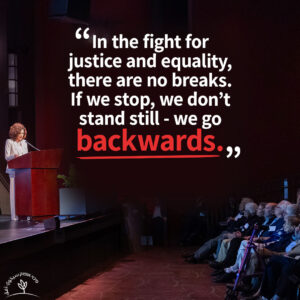
And we need you – our partners more than ever. In the fight for justice and equality, there are no breaks. If we stop, we don’t stand still – we go backwards.
So please, don’t give up on us. Not when it matters most.
Let us walk together, Jews and Arabs, for a future that is shared, just, and equal.
Not someday. Starting now.
Thank you. Shukran.